Calculate Demurrage Charges with a simple formula: (days past free time) × (daily rate) × (number of containers). For example, if your free time is 5 days, your container sits for 8 days, and the daily rate is USD 150, you owe 3 × 150 = USD 450. In practice it is rarely that simple, because most carriers use escalating rates — the longer your container sits, the more each extra day costs.
Here is exactly how it works, with real numbers.
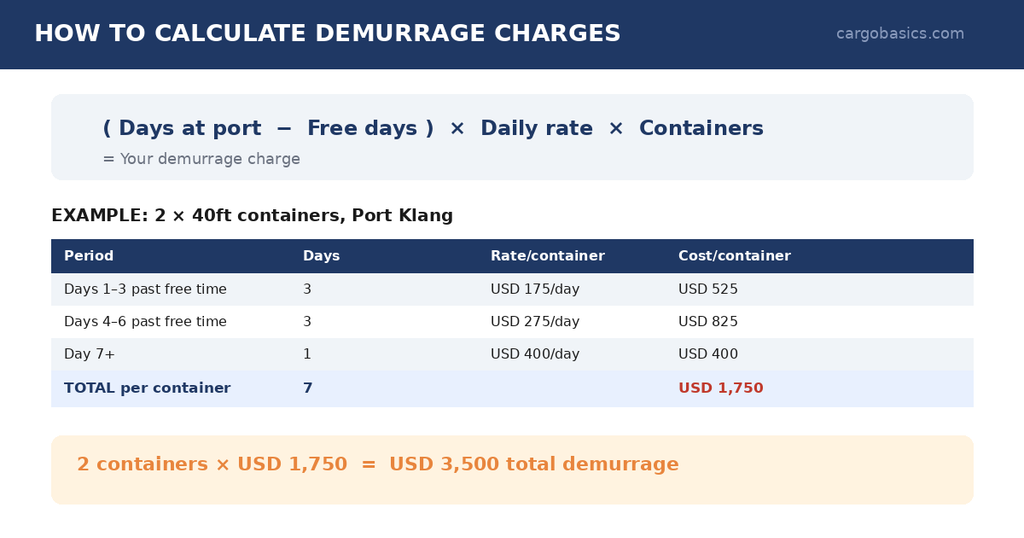
The formula
Demurrage = (Total days at port − Free days) × Daily rate × Number of containers
If the result is zero or negative, you owe nothing. Your container left within free time.
What is free time to Calculate Demurrage Charges?
Free time is the number of days the shipping line allows your container to stay at the port terminal after the vessel arrives — at no charge. This is typically 3 to 7 days depending on the carrier, the port, and your contract.
Important: free time usually starts when the container is discharged from the vessel, not when you receive notification. Weekends count at most ports. So if your container lands on a Thursday and you have 5 free days, free time ends on Tuesday — even though Saturday and Sunday were not working days.
| Region | Typical free time |
|---|---|
| Southeast Asia (including Malaysia) | 5–7 days |
| North America | 4–5 days |
| Europe | 5–7 days |
| India | 3–7 days |
You can negotiate for more free time, especially if you ship regularly with the same carrier. Even one or two extra days can save hundreds of dollars per shipment.
How the tiered rates work
Most carriers do not charge the same rate every day. They use tiers — the rate increases the longer your container stays. This is deliberate. They want you to pick up your container quickly.
Here is a typical tier structure in 2026:
| Days past free time | 20ft container (USD/day) | 40ft container (USD/day) |
|---|---|---|
| Days 1–3 | 75–100 | 150–200 |
| Days 4–6 | 100–150 | 200–300 |
| Day 7+ | 150–250 | 300–500+ |
Refrigerated (reefer) containers cost 1.5 to 2 times more because they occupy powered slots at the terminal.
These are general industry ranges. Your actual rates depend on your carrier, your port, and your contract. Always check the carrier’s published tariff for your specific route.
A real calculation example
You import 2 × 40ft containers into Port Klang, Malaysia. The carrier gives you 5 free days. Due to a customs documentation delay, you pick up the containers on day 12 — that is 7 days past free time.
The carrier’s tariff says:
- Days 1–3 past free time: USD 175/day per 40ft
- Days 4–6: USD 275/day
- Day 7+: USD 400/day
Your calculation:
| Period | Days | Rate per container | Cost per container |
|---|---|---|---|
| Days 1–3 | 3 | USD 175 | USD 525 |
| Days 4–6 | 3 | USD 275 | USD 825 |
| Day 7 | 1 | USD 400 | USD 400 |
| Total per container | 7 | USD 1,750 | |
| Total for 2 containers | USD 3,500 |
A one-week delay on two containers costs USD 3,500. This is on top of your freight, customs duties, and everything else.
Who pays demurrage?
The bill goes to whoever is named as the consignee or the party responsible in the carrier’s booking. In practice:
- Under FOB or CFR terms: the buyer (importer) usually pays, because the buyer is responsible for the cargo once it is on the vessel.
- Under CIF or DDP terms: it depends on the contract, but the seller often bears more of the risk.
- In reality: whoever is slowest to pick up the container pays. If your customs documents are late, you pay. If the port is congested and nobody can get a truck, you may be able to dispute the charges.
Demurrage vs detention — they are different charges
People confuse these constantly. Here is the difference:
| Demurrage | Detention | |
|---|---|---|
| Where | Container is still inside the port terminal | Container is outside the port (at your warehouse) |
| What you are paying for | Using terminal space | Using the carrier’s container/equipment |
| Free time | 3–7 days from vessel discharge | 3–7 days from when you pick up the container |
| Typical rate | USD 75–300/day | USD 50–200/day |
You can be charged both. Demurrage while the container is at the port, then detention after you take it out but before you return the empty container.
How to avoid or reduce demurrage
Before the vessel arrives:
- Have all customs documents ready and submitted through your customs agent before the ship docks. Pre-clearance is the single biggest demurrage saver.
- Confirm the HS code and duty amount in advance so there are no surprises at customs.
- Book your truck or haulier to pick up the container on the day free time ends, not after.
If demurrage has already started:
- Call the carrier immediately. If the delay was caused by port congestion or the carrier’s own late vessel, you may be able to dispute the charges.
- Check your contract for any free time extensions or demurrage caps.
- In some countries (including the US under the FMC regulations), you cannot be charged demurrage for delays caused by the carrier or terminal.
For regular shippers:
- Negotiate more free days into your service contract. Carriers will often give 7–10 free days to regular customers.
- Ask for a flat rate instead of escalating tiers.
- Track your containers actively — do not wait for the notification.
How much does demurrage cost globally in 2026?
Industry estimates put the global cost of demurrage and detention combined at roughly USD 22 billion per year. The average across major trade routes is USD 100 to 150 per container per day.
Asia generally has the lowest demurrage rates (USD 50–120/day). North America has the highest, averaging about USD 138/day, with some US West Coast ports charging over USD 300/day.
Related questions
Sources: Carrier tariff data from FreightAmigo, Xeneta, ShippingRates.org and Dockflow (2026). Industry cost estimate from FMC and Container xChange. Page written and reviewed by Afzal Jamil. Last updated September 2026.
1 thought on “How Do I Calculate Demurrage Charges on a Container?”