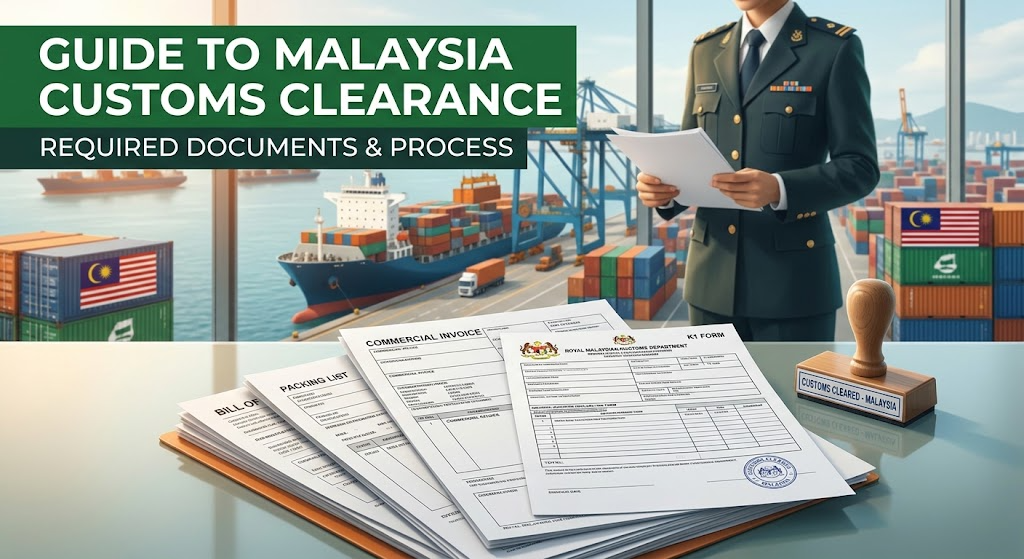
To customs clearance in Malaysia, you need at minimum: a commercial invoice, a packing list, a bill of lading or air waybill, and a customs declaration form (K1 for imports). If your goods are controlled or restricted, you will also need an import permit and possibly a certificate of origin to claim lower duty rates.
Below is the full list, what each document does, and who provides it.
The 6 core documents every importer needs for customs clearance in Malaysia
| Document | What it is | Who provides it |
|---|---|---|
| Commercial invoice | A detailed list of the goods you are importing, with prices, quantities and total value. Customs uses this to calculate how much duty and tax you owe. | Your supplier (the seller) |
| Packing list | Shows how many cartons or pallets, their weights, and dimensions. Customs uses it to verify that the shipment matches the invoice. | Your supplier |
| Bill of lading (sea) or air waybill (air) | Proof that the carrier accepted your goods for transport. It also shows who the goods are going to (the consignee). | The shipping line or airline, through your freight forwarder |
| Customs declaration form (K1) | The official form submitted to the Royal Malaysian Customs Department (JKDM). This declares what you are importing and its value. | Your licensed customs agent submits this through the SMK system |
| Import permit or Approved Permit (AP) | Required only for controlled goods — things like food, cosmetics, pharmaceuticals, chemicals, electronics, alcohol and vehicles. | You apply through the relevant Malaysian agency (MITI, MAQIS, SIRIM, or others depending on the product) |
| Certificate of origin | Proves where the goods were manufactured. You need this to claim lower duty rates under trade agreements like ATIGA (ASEAN), RCEP or CPTPP. | Your supplier’s local chamber of commerce or trade authority |
Which customs form do I use to Customs Clearance in Malaysia?
Malaysia has four main customs forms. Most importers only use K1.
| Form | When you use it |
|---|---|
| K1 | Importing goods into Malaysia for use or sale (this is the one most importers need) |
| K2 | Exporting goods out of Malaysia |
| K8 | Goods in transit or being moved to/from a bonded warehouse |
| K9 | Releasing goods from a bonded or licensed warehouse into Malaysia |
Your customs agent handles the form to customs clearance in Malaysia, not you. But you should know which one applies so you can check their work.
Do I need an import permit to Customs Clearance in Malaysia?
Not always. Most general goods do not need a permit. But these categories do:
- Food and agricultural products — permit from MAQIS
- Cosmetics — notification to NPRA
- Pharmaceuticals and medical devices — approval from NPRA
- Electronics and telecommunications equipment — SIRIM certification
- Chemicals and hazardous materials — permit from relevant ministry
- Meat and poultry — Halal certification plus MAQIS permit
- Vehicles — Approved Permit from MITI
- Alcohol and tobacco — excise licence
If you are not sure whether your product needs a permit, ask your customs agent before the goods ship. Getting a permit after the goods arrive causes delays and storage charges.
How does the customs clearance in Malaysia process work?
Here is the process from the moment your container reaches a Malaysian port:
Step 1 — Documents submitted. Your customs agent uploads all documents through MyCIEDS (the online document system) and lodges the K1 declaration through the SMK system. This can happen before the vessel arrives, which saves time to Customs Clearance in Malaysia.
Step 2 — Customs checks the declaration. The system assigns your shipment to a lane:
- Green lane: cleared automatically, no inspection. Fastest.
- Yellow lane: documents are reviewed manually by a customs officer.
- Red lane: physical inspection of the cargo. Takes longer.
Most routine shipments go through the green lane. Controlled goods, first-time importers, and flagged shipments may go yellow or red.
Step 3 — Duty and tax payment. You pay import duty (based on the HS code of your goods) and sales tax (SST, usually 10% for goods). Payment is made through the customs system.
Step 4 — Cargo released. Once payment is confirmed and any inspection is cleared, customs issues a release order. Your freight forwarder or haulier collects the cargo.
How much does customs clearance in Malaysia cost?
The customs agent fee is typically RM 150 to RM 600 per shipment for standard cargo. This does not include the duty and tax itself — that depends entirely on what you are importing and its value.
The duty is calculated on the CIF value (cost + insurance + freight), not just the product price.
How long does customs clearance in Malaysia take?
- Green lane: same day or next day
- Yellow lane: 1 to 3 working days
- Red lane: 3 to 7 working days, sometimes longer if documents are incomplete
The most common cause of delay in customs clearance in Malaysia is missing or incorrect documents. If your commercial invoice does not match the packing list, or if you need a permit you did not get before shipping, expect delays.
Can I do customs clearance in Malaysia myself?
Legally, yes. You can lodge your own K1 declaration if you have access to the SMK system. But in practice, almost all importers use a licensed customs agent (sometimes called a forwarding agent). The agent has the system access, the customs bond, and the experience to classify your goods correctly.
Using an agent costs RM 150 to 400. Making a classification mistake yourself can cost thousands in wrong duty payments or penalties.
3 things to get right before your goods ship
- Confirm the HS code with your customs agent before the supplier ships. The HS code determines your duty rate. If it is wrong, you either overpay or face penalties.
- Get the commercial invoice and packing list from your supplier early. Your agent can start pre-clearance while the cargo is still on the water.
- Check if you need a permit. Some permits take weeks to obtain. If your goods arrive before the permit does, you pay storage charges every day.
Related questions
Sources: Royal Malaysian Customs Department (JKDM), Malaysia National Single Window, Customs Act 1967. Page written and reviewed by Afzal Jamil. Last updated September 2026.
1 thought on “What Documents Are Needed for Customs Clearance in Malaysia?”