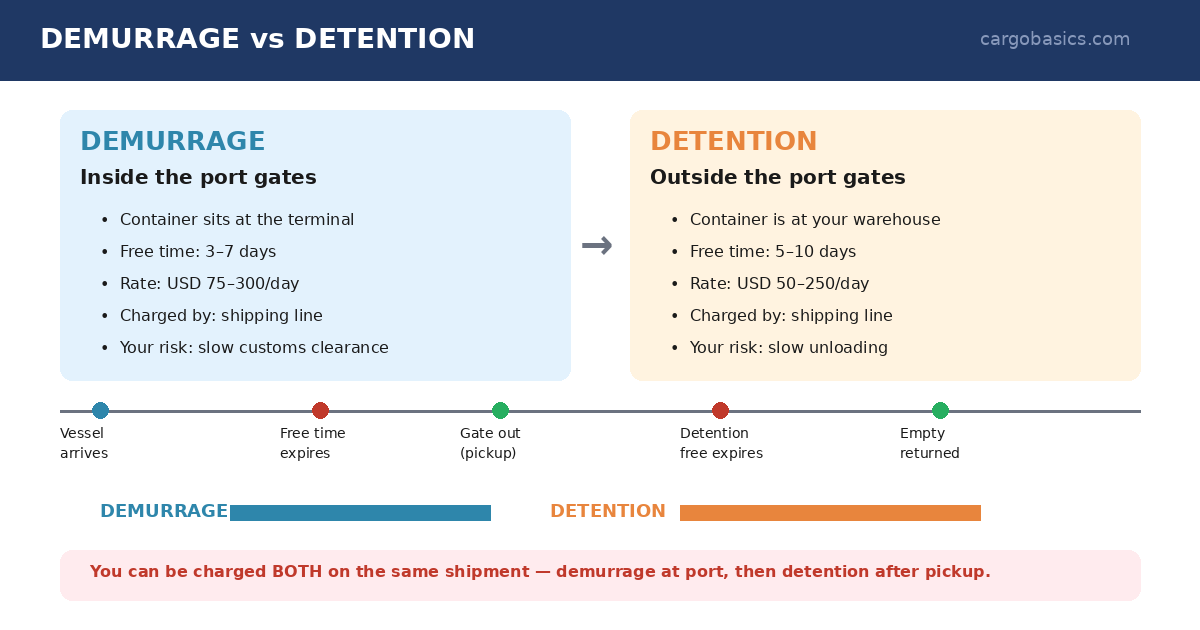
Demurrage is charged while your container sits inside the port terminal. Detention is charged after you take the container out but do not return it to the carrier on time. Both are daily fees, both escalate, and the same shipment can be hit with both, one after the other.
Key facts
- Demurrage: container is inside the port terminal after free time ends.
- Detention: container is outside the port and the empty has not been returned on time.
- Free time: demurrage 3–7 days from discharge, detention 5–10 days from gate-out.
- Typical 2026 rates: demurrage USD 75–300 per day, detention USD 50–250 per day.
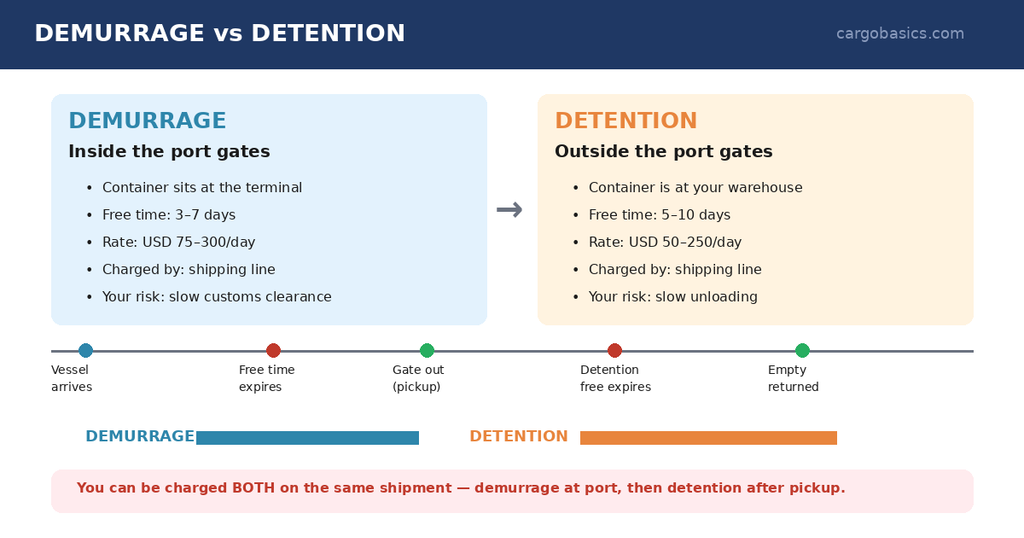
The simplest way to remember it: demurrage = inside the port gates. Detention = outside the port gates.
Demurrage vs detention side by side
| Demurrage | Detention | |
|---|---|---|
| Where the container is | Inside the port terminal | Outside the port — at your warehouse, factory or yard |
| What you are paying for | Using terminal storage space | Using the carrier’s container equipment |
| Who charges it | Shipping line (sometimes the terminal separately) | Shipping line |
| Free time | 3–7 days from vessel discharge | 5–10 days from when you pick up the container |
| Typical daily rate (2026) | USD 75–300 per container | USD 50–250 per container |
| Rates escalate? | Yes — increases after each tier | Yes — same tiered structure |
When does each one start?
Demurrage clock starts the moment the container is unloaded from the vessel onto the terminal yard. Not when you receive notification. Not when you arrange a truck. The moment it touches the ground.
Detention clock starts when you take the container out of the port (gate-out). It runs until you return the empty container to the carrier’s designated depot.
Here is the timeline of a typical import shipment:
| Stage | What happens | Which charge applies |
|---|---|---|
| 1 | Vessel arrives, container is discharged to terminal | Free time starts (demurrage) |
| 2 | Container sits at terminal for 3 days | Still within free time — no charge |
| 3 | Day 6 — container still at terminal, free time was 5 days | Demurrage starts — USD 75–150/day |
| 4 | Day 8 — you finally pick up the container (gate-out) | Demurrage stops. Detention free time starts. |
| 5 | You unload at your warehouse over 4 days | Still within detention free time — no charge |
| 6 | Day 15 — empty container still at your warehouse | Detention starts — USD 50–125/day |
| 7 | Day 18 — you return the empty container to depot | Detention stops. |
In this example you paid 3 days of demurrage and 3 days of detention.
Can I be charged both at the same time?
In most cases, no — demurrage applies at the port, detention applies outside. They are sequential. Demurrage ends when the container leaves the port, and detention begins after that.
However, in some countries (notably India), carriers apply both charges simultaneously. And if you have multiple containers, some might be at the port (demurrage) while others are at your warehouse (detention) at the same time.
Always check the carrier’s tariff for your specific trade lane.
Which one costs more?
Demurrage is usually more expensive. Terminal space is limited and valuable, so carriers charge more to discourage long stays. Detention rates are typically lower because the container is not blocking port operations.
However, detention periods tend to be longer — it takes time to unload, especially if you have a small team or warehouse scheduling problems. A lower daily rate over more days can cost just as much.
Why do these charges exist?
Carriers own millions of containers worldwide. Each container needs to keep moving — it gets loaded, shipped, unloaded, returned, and loaded again. When your container sits idle, the carrier cannot use it for someone else.
Demurrage and detention are not random penalties. They exist to keep containers circulating. The global shipping industry estimates these charges cost about USD 22 billion per year.
How to reduce demurrage charges
- Submit customs documents before the vessel arrives so clearance starts immediately
- Pre-book your truck to collect on the day free time ends
- Negotiate extra free days in your service contract — carriers will often give 7–10 days to regular shippers
- If port congestion caused the delay, dispute the charges — in many jurisdictions you should not pay for delays you did not cause
How to reduce detention charges
- Have your warehouse and labour ready before the container arrives
- Unload and return the empty container as fast as possible — ideally same day
- If you need more time, negotiate detention free time separately from demurrage
- Strip the container at the port (CFS) instead of taking it to your warehouse — this avoids detention entirely, though you pay a CFS handling fee instead
Related questions
- How do I calculate demurrage charges on a container?
- What documents are needed for customs clearance in Malaysia?
- How do I make sure my China freight quote has no hidden charges?
Sources: Carrier tariff structures from FreightAmigo, FourKites, and ShipFinex (2026). Industry cost estimate from Container xChange. Page written and reviewed by Afzal Jamil. Last updated September 2026.