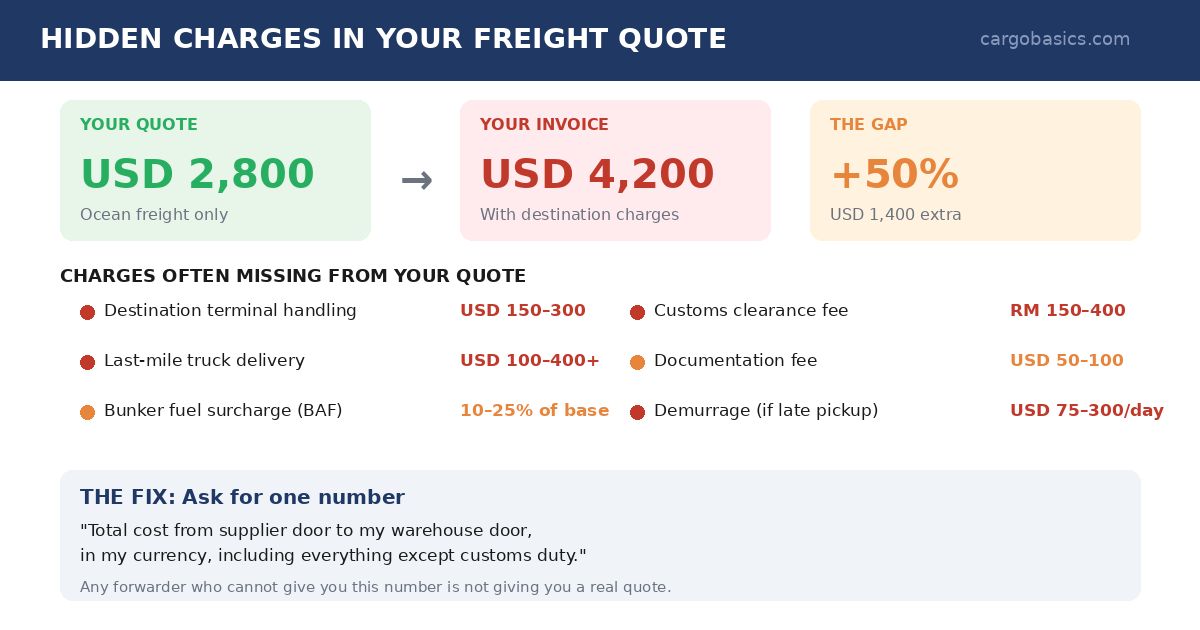
Ask for a full door-to-door landed cost breakdown, not just the ocean freight rate. A typical freight quote from China shows only the base rate — the port-to-port cost. The charges that actually hurt you are the ones at destination: terminal handling, customs clearance, demurrage, documentation fees and last-mile delivery. These can add 15 to 25 percent on top of your quoted rate.
Key facts
- Main issue: most China quotes are port-to-port. Destination charges can add 15–25%.
- Often missing: destination terminal handling, customs clearance, delivery, and duty and SST.
- What to ask for: an itemised door-to-door landed cost in your currency.
- CIF trap: CIF does not cover charges at the destination port.
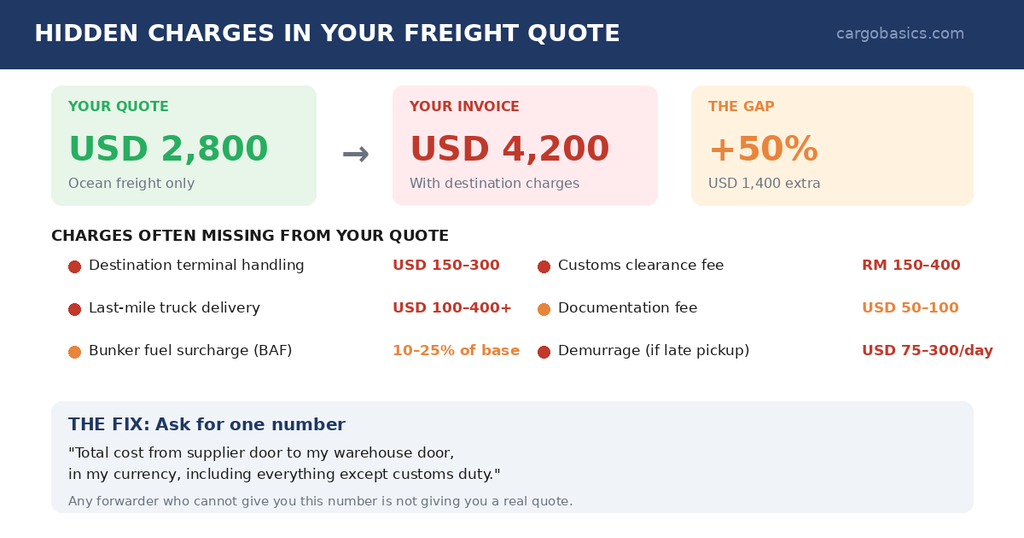
Here is every charge that might be missing from your quote, and exactly what to ask your forwarder before you ship.
The problem: why the invoice never matches the quote
A forwarder quotes you USD 2,800 for a 40ft container from Shanghai to Port Klang. You budget USD 2,800. The invoice arrives at USD 4,200. What happened?
The quote covered only the ocean freight — port to port. Everything else was charged separately, at destination, after you had already committed.
Here is a real breakdown of where the extra money goes:
| Charge | What it is | Typical range (40ft) | Was it in the quote? |
|---|---|---|---|
| Base ocean freight | Port-to-port transport | USD 1,800–3,400 | Usually yes |
| Origin terminal handling (THC) | Crane and yard operations at the China port | USD 120–200 | Sometimes |
| Bunker adjustment factor (BAF) | Fuel surcharge — changes monthly | 10–25% of base rate | Sometimes |
| Documentation fee | Bill of lading preparation | USD 50–100 | Sometimes |
| Destination terminal handling | Crane and yard operations at Port Klang | USD 150–300 | Often missing |
| Customs clearance | Your customs agent’s fee | RM 150–600 | Often missing |
| Import duty and SST | Tax on your goods — depends on HS code | Varies widely | Almost never included |
| Last-mile delivery | Truck from port to your warehouse | USD 100–400+ | Often missing |
| Demurrage risk | If your container is not picked up in time | USD 75–300/day | Never included |
The first four items are origin charges. Forwarders usually include them. The last five are destination charges. Forwarders often leave them out — not because they are dishonest, but because the quote is for their service (moving the box), not yours (clearing and collecting it).
The 8 questions to ask before you accept any quote
Print this list. Send it to your freight forwarder. Any forwarder who cannot answer all eight is not giving you a real quote.
1. Is this quote door-to-door or port-to-port? If port-to-port, ask them to requote door-to-door. Otherwise you are comparing half the cost.
2. Does this include origin AND destination terminal handling charges? THC at both ends can add USD 250–500 total. If it is not listed, it will appear on the invoice later.
3. What surcharges are included — BAF, CAF, PSS, EBS? These acronyms are fuel surcharge (BAF), currency adjustment (CAF), peak season surcharge (PSS), and emergency bunker surcharge (EBS). Ask which ones are included and which will be added later.
4. What is the documentation fee? This is usually USD 50–100 but some forwarders charge more. Get it in writing.
5. What happens if I need extra free time at the port? Ask how many free days are included and what the demurrage rate is after that. This is especially important if your customs clearance is slow.
6. Does this include customs clearance at destination? If not, who arranges it and what does it cost? Budget RM 150–600 in Malaysia (here are the documents you will need).
7. Does this include delivery from the port to my warehouse? Last-mile trucking is often the biggest missing charge. Get a specific number.
8. Are there any charges that will be invoiced separately after the shipment arrives? This is the catch-all question. Any honest forwarder will list them.
FOB vs CIF vs DDP — what each one actually covers
Your Incoterm determines which charges are the seller’s problem and which are yours:
| Incoterm | What the seller pays for | What you still pay |
|---|---|---|
| FOB (Free on Board) | Getting the goods onto the vessel at the China port | Everything from that point: ocean freight, insurance, destination charges, customs, delivery |
| CIF (Cost, Insurance, Freight) | Everything up to the destination port, including freight and insurance | Destination terminal handling, customs clearance, duty, delivery |
| DDP (Delivered Duty Paid) | Everything including duty and delivery to your door | Almost nothing — but verify exactly what “everything” means |
The trap with CIF: your supplier includes freight and insurance, but destination charges are still yours. Many first-time importers think CIF means “all costs covered.” It does not.
The trap with DDP: your supplier says they handle everything. But some DDP quotes exclude customs inspection fees, warehouse storage, or local taxes. Always ask for an itemised breakdown of what DDP covers.
How to compare two freight quotes properly
Never compare the base freight rate. Compare the total landed cost.
Take the quote → add every charge you will pay at destination → add customs duty → add delivery → that is your real number.
If forwarder A quotes USD 2,000 for ocean freight and forwarder B quotes USD 2,500, but forwarder B includes destination handling, clearance and delivery while A does not, forwarder B is probably cheaper.
A simple rule that prevents most surprises
Ask your forwarder to give you one number: the total cost from the supplier’s door to your warehouse door, in your currency, including everything except customs duty.
Customs duty depends on your goods and HS code, so the forwarder cannot quote it exactly. Everything else, they should be able to itemise.
If they refuse or say “we can’t estimate destination charges,” find a different forwarder. A good forwarder knows exactly what charges apply at both ends.
Related questions
- How do I calculate demurrage charges on a container?
- What documents are needed for customs clearance in Malaysia?
- What is the difference between demurrage and detention?
Sources: Charge ranges from FreightAmigo, TopwayShipping, GoldenFreight, and AEB Logistics (2026). Typical Malaysia customs clearance costs from industry sources. Page written and reviewed by Afzal Jamil. Last updated September 2026.